At a glance
- Best for
- Roman history, island hopping, beaches and nightlife
- Airport
- Split Airport (SPU), around half an hour west of the city
- Time needed
- Two to three days, plus islands
- Best season
- May, June and September
- Getting around
- Walking in the centre, local buses and ferries
- Good base for
- Hvar, Brač, Vis, Trogir, Krka and Omiš
Why go
Few places let you walk through such complete Roman history as part of daily life. Split is lively, sunny and practical, with a seafront promenade, good beaches within walking distance, and boats to the islands from the harbour in front of the old town.
Diocletian's Palace
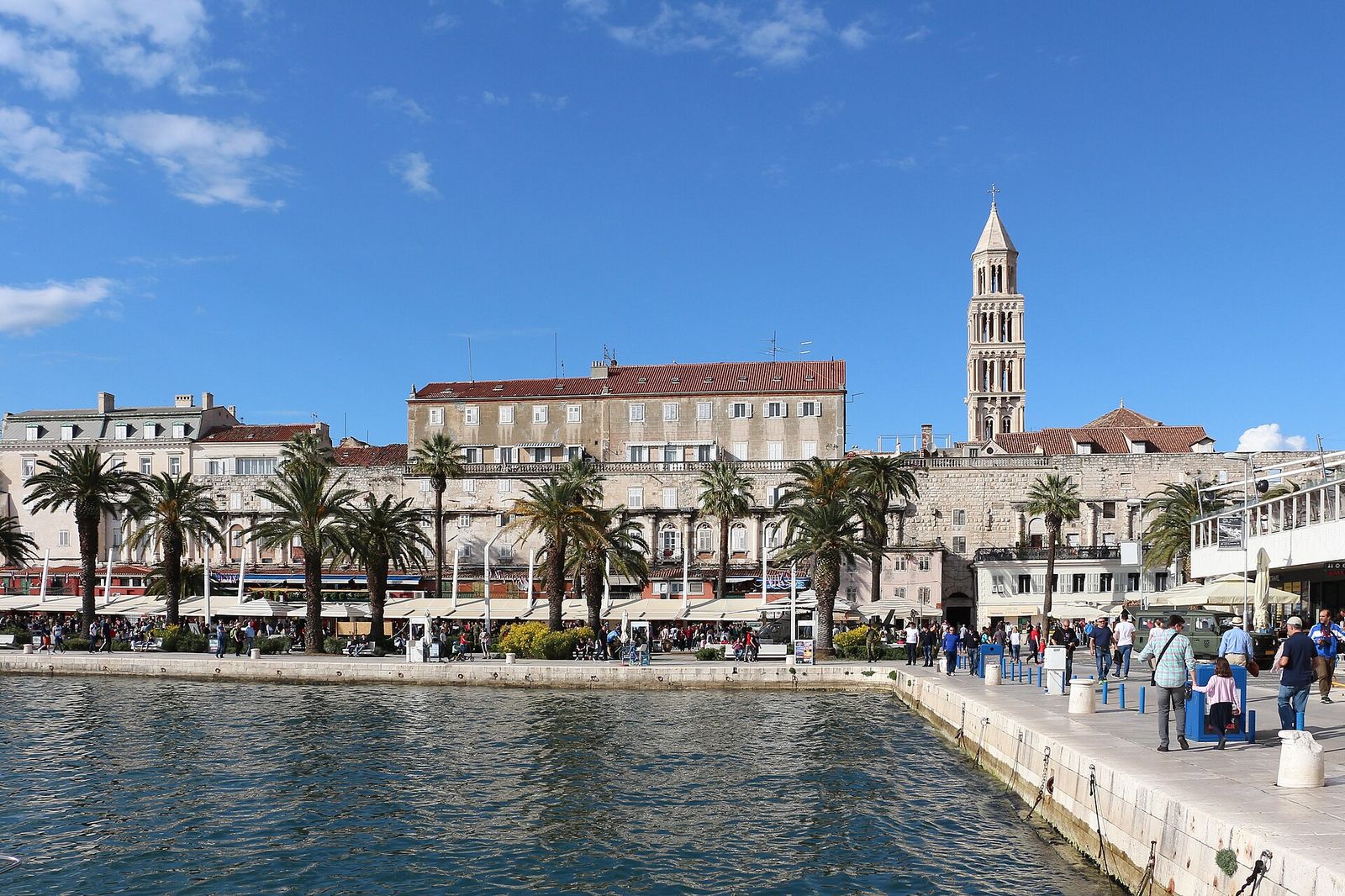
The palace, part of a UNESCO World Heritage site, takes up much of the old town. Start at the **Peristyle**, the colonnaded central square, then climb the bell tower of the **Cathedral of St Domnius**, built around the emperor's mausoleum. Below, the vaulted **substructures** (cellars) show the original floor plan; you may recognise them from television. Enter by the **Golden Gate**, where the statue of **Grgur Ninski** has a toe rubbed shiny for luck. Lanes lead out to **People's Square (Pjaca)** and the medieval streets beyond.
The Riva and Marjan
The palm lined **Riva** promenade runs along the old town's sea wall and is the city's living room at all hours. West of the centre, **Marjan hill** is a forest park with steps to viewpoints, small chapels, walking and cycling paths and swimming spots such as **Kašjuni**. On the way, the **Meštrović Gallery** displays work by Croatia's greatest sculptor in his seaside villa.
Beaches
**Bačvice**, a shallow sandy bay a short walk east of the station, is the city beach, where locals play **picigin**, a splashing ball game in the shallows. Further east are **Firule** and **Žnjan**, and Marjan has rocky coves for quieter swims.
Day trips
**Trogir**, a tiny walled island town, is half an hour away by bus or boat. **Krka National Park** has waterfalls and walkways near **Šibenik**. **Omiš** sits at the mouth of the **Cetina** river canyon, good for rafting and zip lines. **Klis Fortress** guards the hills above the city. By sea, catamarans reach **Hvar**, **Brač**, **Vis** and **Korčula**, and many boat tours visit the **Blue Cave** near Vis.
Where to stay
Inside or right beside the palace puts you in the action but can be noisy at night. **Varoš**, the old fishermen's quarter below Marjan, is quieter and full of character. **Bačvice** and **Firule** suit beach lovers. There are boutique hotels in palace buildings, apartments and many hostels.
Getting there and around
Split Airport is between Split and Trogir, linked by shuttle bus, local buses and taxis. The bus station, railway station and ferry port sit side by side next to the old town. Book catamaran seats to the islands ahead in summer, as they sell out.
Practical tips
In July and August, the old town is very crowded when cruise passengers arrive, so explore early or in the evening. Keep an eye on bags in the narrow lanes.
Food to try
Split is a good place to taste Dalmatian home cooking. Look for **pašticada**, beef slow cooked in wine and prunes and served with gnocchi, **crni rižot**, black risotto coloured with cuttlefish ink, grilled fish with **blitva** (chard and potatoes), and **soparnik**, a thin chard pie from the hills around Poljica. Small family run konobas in **Varoš** and the lanes north of the palace are often better and calmer than the terraces on the Riva. For a sweet treat, try **rožata**, a caramel custard, and fruit from the Pazar market for a picnic on Marjan.
Questions about Split
How many days do I need in Split?
Two days covers the palace, the Riva, Marjan and a beach. Add more for day trips to Trogir, Krka or the islands.
How do I get from Split to Hvar?
Catamarans run to Hvar Town and car ferries run to Stari Grad. Check timetables and book on the Jadrolinija or other operators' sites, especially in summer.
Is Split a good base for island hopping?
Yes. It is the main ferry hub for central Dalmatia, with boats to Hvar, Brač, Vis, Šolta and Korčula.
Is Split very busy in summer?
Yes, especially in the old town at midday in July and August. Mornings and evenings are calmer, and May, June and September are more relaxed.
Facts checked . Fees, schedules and entry rules change, so always confirm the latest with the official source.