At a glance
- Best for
- Food, beaches, families and architecture
- Airport
- Valencia (VLC), about twenty to thirty minutes by metro
- Time needed
- Two to three days
- Best season
- April to June and September to October
- Getting around
- Walking, cycling, metro and trams
- Good to know
- Eat paella at lunchtime, the local way
Why go
Valencia is easy to love. It is flat and sunny, made for walking and cycling, with a lively bar scene and a strong local identity, including its own language, Valencian. It is two hours or less from Madrid by high speed train and makes a perfect stop between Madrid and Barcelona.
The old town
The **Ciutat Vella** is a compact maze of squares and lanes. The **cathedral** keeps a chalice venerated as the Holy Grail, and you can climb the **Miguelete** bell tower for views. The **Lonja de la Seda**, a UNESCO listed Gothic silk exchange, has a hall of twisting columns. Across the street, the **Mercado Central** is one of Europe's finest food markets, under a modernista dome. Walk through the medieval **Torres de Serranos** and **Torres de Quart** gates and explore the **El Carmen** quarter for murals, bars and the remains of the old walls.
Turia Gardens and the City of Arts and Sciences
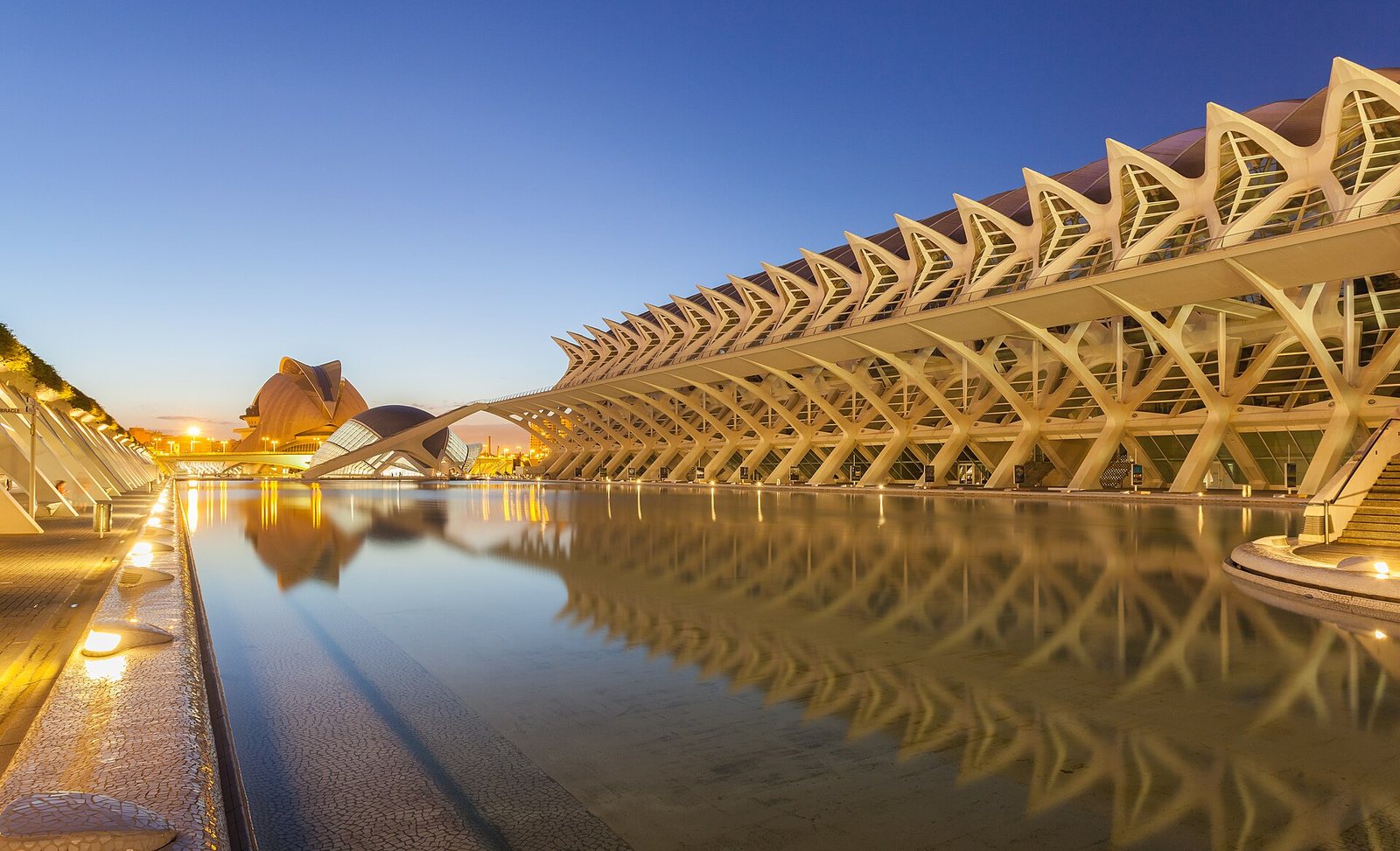
After a disastrous flood in 1957, Valencia diverted its river and turned the old bed into the **Turia Gardens**, a long ribbon of parks, playgrounds, sports fields and paths that curves around the old town. Rent a bike and follow it to the **City of Arts and Sciences**, a series of white futuristic buildings by Santiago Calatrava and Félix Candela set in shallow blue pools. Inside are a science museum, an IMAX dome, an opera house and the **Oceanogràfic**, Europe's largest aquarium, a family favourite.
Beaches
**Malvarrosa**, **Las Arenas** and **Patacona** are long, wide sandy beaches reached by tram or bike. Behind them, **El Cabanyal**, the old fishermen's district, has colourful tiled houses and traditional bars. South of the city, the coast runs along the **Albufera Natural Park**, a freshwater lagoon surrounded by rice paddies.
Paella and Valencian food
True **paella valenciana** is made with chicken, rabbit, green beans and garrofó beans, cooked in a wide pan over a wood fire until a crisp layer, the socarrat, forms on the bottom. Locals eat it at lunch, often on Sundays. Also try **arroz a banda**, rice cooked in fish stock, **arroz negro** with squid ink, **all i pebre**, eel stew from the Albufera, and **horchata**, a cold tiger nut drink with sweet **fartons** for dipping. Agua de Valencia, a cocktail of orange juice and cava, is the local party drink.
Las Fallas
Every March, Valencia stages **Las Fallas**, a UNESCO listed festival of huge satirical sculptures, daily firecracker displays called mascletàs, flower offerings and fireworks, ending with nearly all the sculptures burned on the night of 19 March. It is loud, crowded and spectacular. Book well ahead if you want to go, or visit the **Museo Fallero** to see the figures saved from the flames.
The Albufera
A short bus ride south, the **Albufera** lagoon is the birthplace of paella. Take a flat bottomed boat out on the water at sunset, then eat rice in the village of **El Palmar**.
Where to stay
The **old town** is best for first visits. **Ruzafa** is the trendy district of cafés and bars. **El Cabanyal** and the seafront suit beach lovers, and the area near the City of Arts and Sciences is good for families. Valencia's region has introduced a tourist tax; check current rules before you book.
Getting around
Valencia is flat and great for cycling, with a public bike scheme and many rental shops. The metro links the airport with the centre, and trams run to the beaches.
See all our Spain destinations or use the free trip planner to add Valencia to your route.
Questions about Valencia
How many days do I need in Valencia?
Two days covers the old town, the City of Arts and Sciences and the beach. Add a third for the Albufera and a long paella lunch.
Where can I eat authentic paella in Valencia?
Head to the restaurants along Malvarrosa beach or to El Palmar in the Albufera, and order at lunchtime. Many places cook paella to order for two or more people.
Is Valencia good for families?
Very. The Turia Gardens playgrounds, the Oceanogràfic, the science museum, Bioparc and the beaches make it one of Spain's best family cities.
When does Las Fallas take place?
The main days are 15 to 19 March each year, with events building through early March. Check the official tourism site for the programme.
Facts checked . Fees, schedules and entry rules change, so always confirm the latest with the official source.