At a glance
- Best for
- Harbour life, architecture, music, seafood and nightlife
- Main airport
- Hamburg (HAM), about twenty-five minutes by S-Bahn
- Time needed
- Two to three days
- Best season
- May to September
- Getting around
- U-Bahn, S-Bahn, buses and harbour ferries
- Good base for
- Lübeck, the Baltic coast, Lüneburg and Berlin
Why go
Hamburg is a city built around water. The great harbour, the canals of the Speicherstadt and the two Alster lakes give it a character all its own, and its museums, concert halls and theatres make it one of Germany's great cultural cities. It is also a city of contrasts: polished merchant houses on one side, the neon of the Reeperbahn on the other.
The main sights
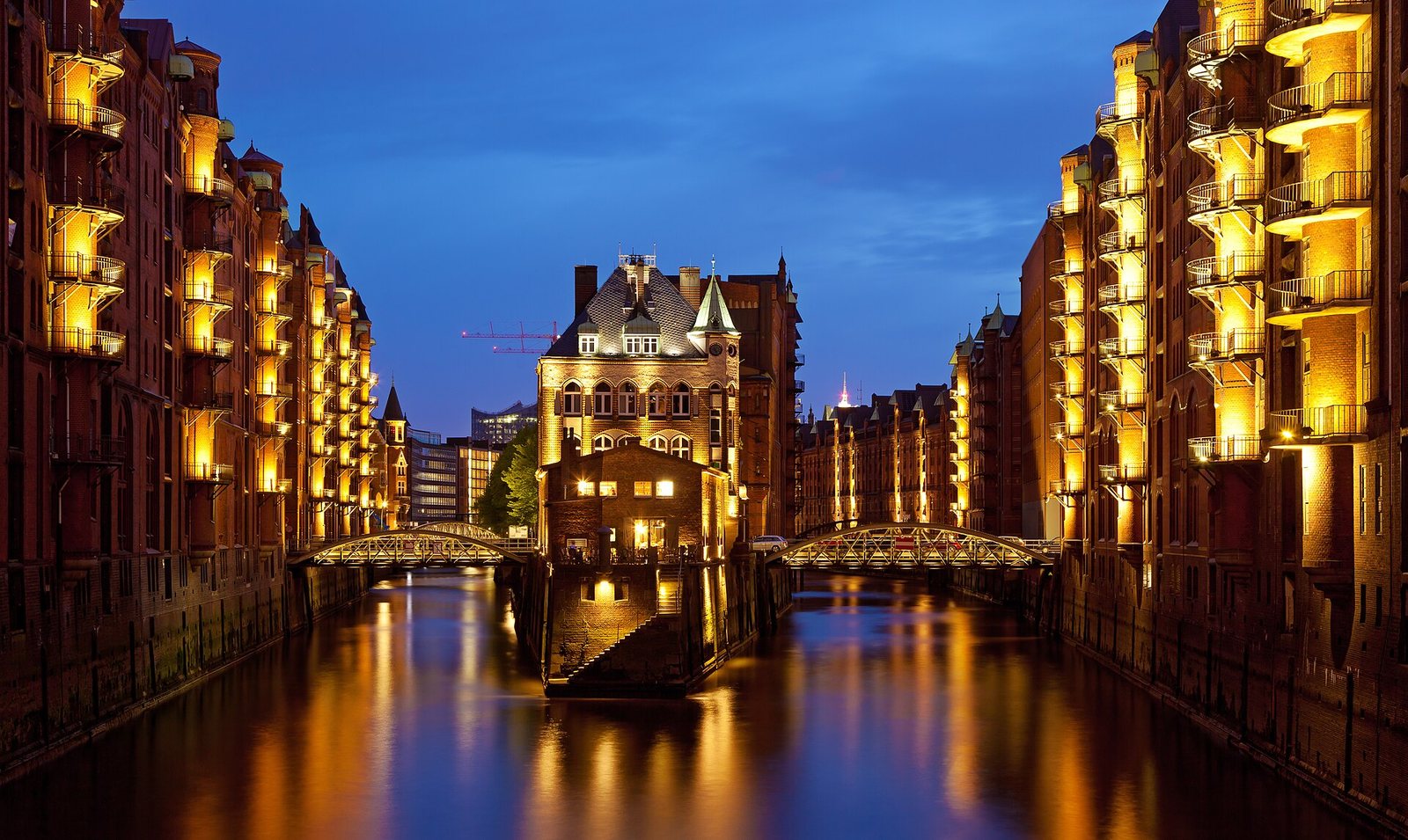
The **Speicherstadt**, a UNESCO-listed warehouse district of red-brick buildings on oak piles, is the city's most photographed corner. It houses **Miniatur Wunderland**, the world's largest model railway and one of Germany's most popular attractions; book a time slot ahead. Next door, **HafenCity** is a modern waterfront district crowned by the **Elbphilharmonie**, a concert hall with a wave-shaped glass roof. The public viewing plaza gives wide views over the harbour; tickets are free on the spot or bookable online for a small fee.
The grand **Rathaus** (city hall) and the elegant arcades around the **Binnenalster** lake mark the city centre. A walk or boat trip on the **Aussenalster** shows the leafy side of Hamburg. **St Michael's Church**, known as the Michel, has a tower with a sweeping view.
The harbour
Hamburg's port is best seen from the water. Public HVV ferries, such as line 62 from Landungsbrücken to Finkenwerder, are included in a normal transport ticket and give a good harbour view at a fraction of a tour's cost. The old **Elbe Tunnel**, opened in 1911, lets you walk under the river to a viewpoint of the skyline.
The fish market and St Pauli
The **Fischmarkt** in Altona runs early on Sunday mornings, with traders shouting their offers and a live band in the old auction hall. It is a Hamburg rite of passage, especially after a night out. **St Pauli** and the **Reeperbahn** are the city's nightlife district, with clubs, music venues, theatres and the Beatles-Platz, where the band played in their early days. It is lively and mostly safe, but watch your belongings and avoid touts.
Neighbourhoods
The **Schanzenviertel** is alternative and full of cafés and bars. **Ottensen** in Altona is relaxed, with independent shops and restaurants. **Blankenese**, on the Elbe to the west, is a former fishing village of steep lanes and villas, with a riverside beach. **Eppendorf** and **Winterhude** are elegant residential areas near the Alster.
Food
Try a **Fischbrötchen**, a bread roll with pickled herring, smoked salmon or fried fish, from a harbour stall, and **Franzbrötchen**, a cinnamon pastry. **Labskaus**, a sailor's dish of corned beef, potato and beetroot topped with a fried egg, is a local classic. Hamburg also has a strong coffee culture and an excellent Portuguese quarter near the harbour.
Day trips
**Lübeck**, the old capital of the Hanseatic League, with its Holstentor gate and marzipan, is under an hour by train. **Lüneburg** has a medieval old town, and the Baltic beaches of Travemünde and Timmendorfer Strand are popular in summer.
Where to stay
The **Altstadt** and **Neustadt** are central and close to the sights. **St Georg**, near the main station, has good restaurants and is close to the Alster, though the area right by the station can feel rough at night. The Schanzenviertel and St Pauli suit night owls, and HafenCity is modern and quieter.
Questions about Hamburg
How many days do I need in Hamburg?
Two to three days covers the Speicherstadt, Elbphilharmonie, harbour, a fish market morning and a couple of neighbourhoods. Add a day for Lübeck.
When is the Hamburg Fish Market?
It is held on Sunday mornings in Altona, starting very early and finishing mid-morning, with slightly later hours in winter. Check the city's official site for the current times.
Is the Reeperbahn safe?
Generally yes, it is busy and well policed. Keep valuables close, ignore touts and avoid getting drawn into bars with unclear prices.
Do I need to book Miniatur Wunderland?
It is strongly recommended, especially at weekends and in school holidays, as time slots sell out. Book on the attraction's official website.
Facts checked . Fees, schedules and entry rules change, so always confirm the latest with the official source.