At a glance
- Best for
- Architecture, families, nightlife and relaxed city breaks
- Airport
- Wrocław Copernicus Airport (WRO), about thirty minutes from the centre
- Time needed
- Two to three days
- Best season
- May to September, plus December for the Christmas market
- Getting around
- Walking, trams and city bikes
- Good base for
- Książ Castle, the Churches of Peace and the Karkonosze mountains
Why go
Wrocław feels like a smaller, calmer Kraków, with fewer crowds and plenty of character. Its layered history, from Silesian dukes to German Breslau, gives it a mix of Gothic, baroque and modernist architecture, and a big student population keeps cafés and bars buzzing.
What to see
The **Market Square** (Rynek) is one of the largest in Europe, surrounded by gabled houses painted in every colour and centred on the Gothic **Old Town Hall**, home to one of the oldest restaurants in Europe in its cellar. Next door, the smaller **Salt Square** has a flower market.
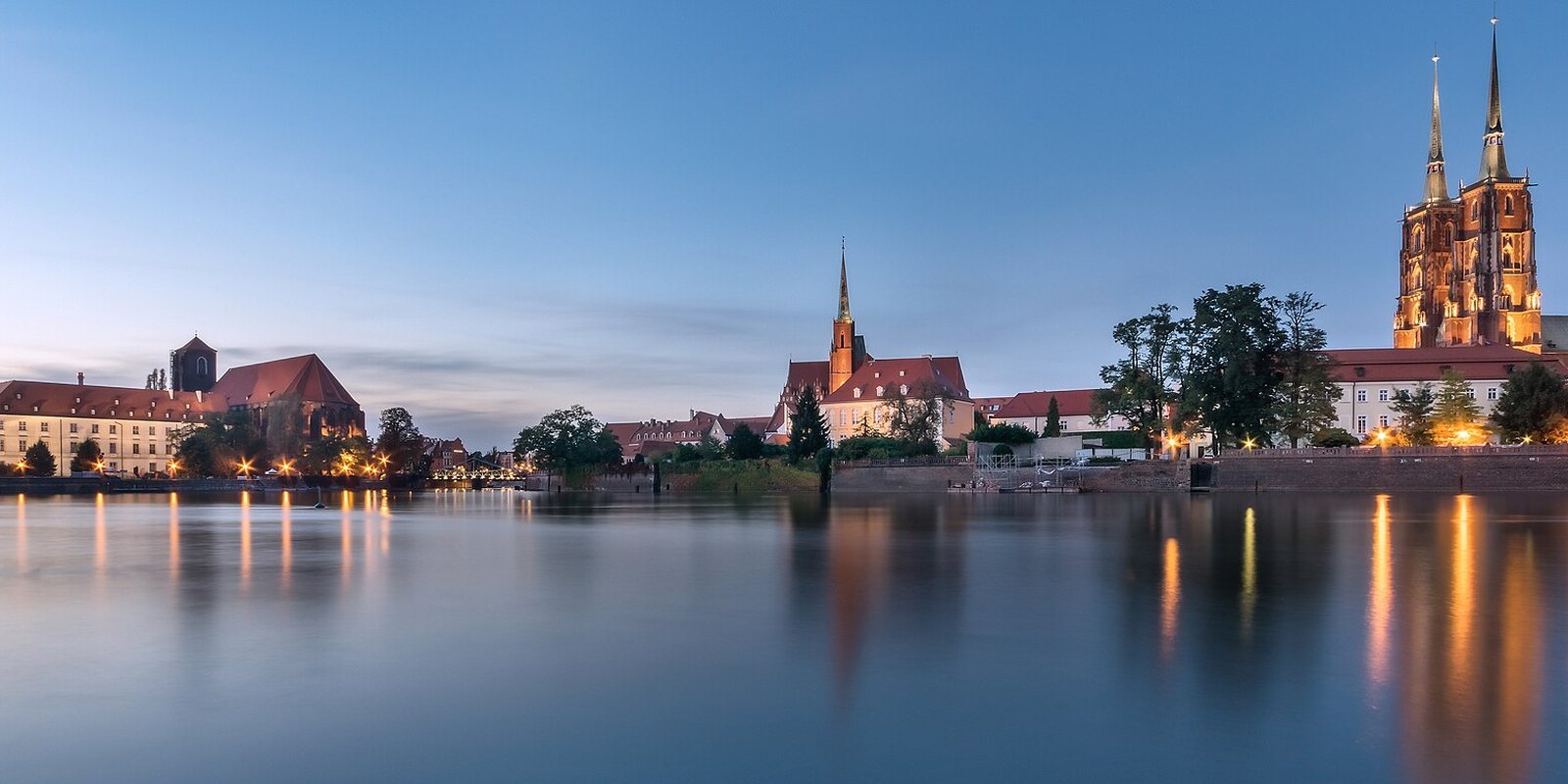
Cross the bridges to **Ostrów Tumski**, Cathedral Island, the oldest part of the city. At dusk a lamplighter still lights the gas lamps by hand. Climb the tower of the **Cathedral of St John the Baptist** for the view, and look for love padlocks on the Tumski Bridge.
The **Racławice Panorama** is a giant circular painting of a 1794 battle, viewed from a platform in the centre. **Centennial Hall**, a UNESCO listed concrete dome from 1913, sits beside the **Japanese Garden** and the **Multimedia Fountain**, which holds evening shows in summer. The **University of Wrocław** has a baroque Aula Leopoldina and a tower with a mathematical viewing terrace, and the **Hydropolis** water museum is great for families.
The dwarfs
More than six hundred small bronze dwarfs, or krasnale, are scattered around the city, each with a job or a personality: a firefighter, a banker, a dwarf on a laptop. They began as a nod to the Orange Alternative, a playful anti communist movement of the 1980s. Picking up a map and hunting for them is a joy for children and adults alike.
Neighbourhoods
The **Old Town** holds most sights. **Nadodrze**, north of the river, is a creative area of street art, galleries and cafés. The riverside boulevards and islands such as **Słodowa Island** fill with young people on summer evenings.
Day trips
**Książ Castle**, one of the largest castles in Poland, sits above a forested gorge near Wałbrzych. The **Churches of Peace** in Świdnica and Jawor are huge timber framed churches with UNESCO status. The **Karkonosze** mountains around Karpacz and Szklarska Poręba offer hiking and skiing.
Food and drink
Try pierogi, żurek, Silesian dumplings and roast duck, and look for craft beer bars around the square. The Christmas market on the Rynek is one of the best in Poland, with mulled wine and wooden stalls.
Where to stay
The **Old Town** is the obvious choice. Areas near the **river and Cathedral Island** are quieter and scenic, and the area around the **main station** has good value hotels and easy transport.
Getting around
The centre is walkable, trams cover the wider city and city bikes are popular in summer. Trains link Wrocław to Kraków, Warsaw, Poznań, Berlin and Prague.
Good to know
Summer evenings by the river are the highlight. Some museums close on Mondays, so check before you go.
Families
Children love the dwarf hunt, the Afrykarium at the zoo, Hydropolis and boat or pedalo rides on the Oder. The Old Town is flat and compact, which makes it easy with a pushchair, and parks such as Szczytniki give everyone space to run around on a sunny afternoon.
Questions about Wrocław
How many days do I need in Wrocław?
Two days covers the main sights comfortably. Add a third for Książ Castle or the Churches of Peace.
What are the Wrocław dwarfs?
Small bronze statues scattered around the city, each with its own character. Maps are sold at the tourist office and shops, and hunting for them is a favourite pastime.
How do I get to Wrocław from Kraków?
Direct trains take around three hours, and buses are also frequent.
Is Wrocław good for nightlife?
Yes. The Market Square, Ruska Street and the riverside islands are busy with bars, especially on summer weekends.
Facts checked . Fees, schedules and entry rules change, so always confirm the latest with the official source.