At a glance
- Best for
- History, architecture, museums and wine
- Airport
- Budapest (BUD), about three hours
- Time needed
- Two days, plus a day for Villány
- Best season
- April to June and September to October
- Getting around
- Walking, local buses and taxis
- Good base for
- Villány wine region, Siklós and the Mecsek hills
Why go
Pécs feels different from the rest of Hungary. Its squares are full of café tables, its streets climb toward green hills and its monuments mix Roman, Christian, Ottoman and art nouveau in one walk. It is lively thanks to a big student population, but calm compared with Budapest.
Széchenyi Square and the Mosque Church
The main square is dominated by the green domed **Mosque of Pasha Qasim**, built by the Ottomans in the sixteenth century on the site of a church and turned back into a Catholic church after their departure. Inside you can still see the mihrab and Arabic inscriptions. Nearby, the **Zsolnay Fountain** has green eosin glazed bulls' heads. Down the hill, the **Mosque of Pasha Yakovali Hassan** is the best preserved Ottoman mosque in Hungary, complete with its minaret.
The early Christian necropolis
Under the streets around the cathedral lie burial chambers from the fourth century, when the town was the Roman city of Sopianae. The site, listed by UNESCO, is shown in the **Cella Septichora Visitor Centre**, where glass walkways pass over painted tombs. The paintings of Adam and Eve, Peter and Paul are rare survivors of early Christian art.
The cathedral and museums
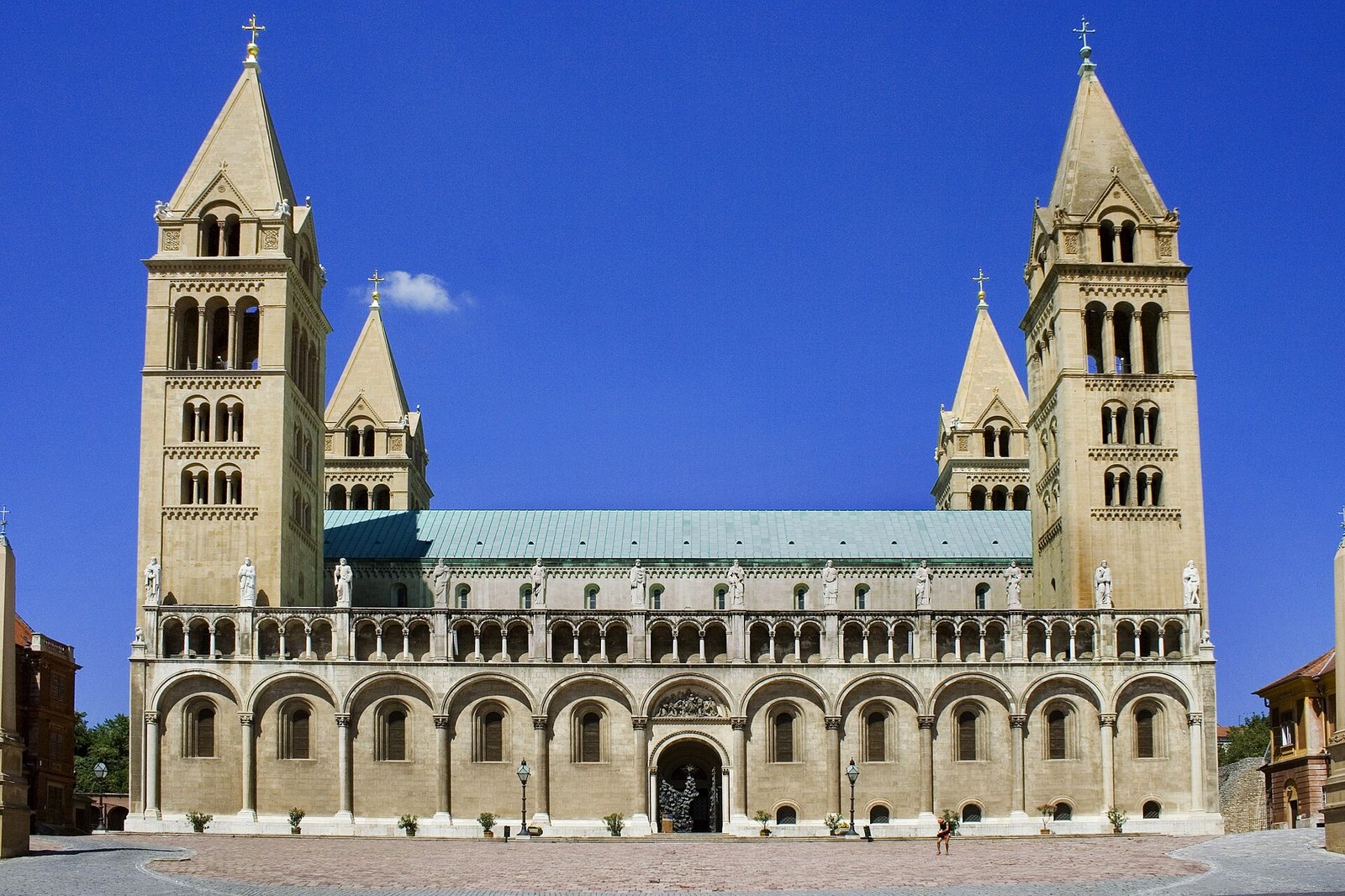
The four towered **Pécs Cathedral** stands on Dóm Square, with a richly painted interior. **Káptalan Street** nearby is lined with museums, including the **Csontváry Museum**, devoted to the visionary painter Tivadar Csontváry Kosztka, and the **Victor Vasarely Museum**, for the father of op art, who was born in Pécs.
The Zsolnay Cultural Quarter
The Zsolnay family ceramics factory, known for its colourful glazes and roof tiles used on buildings across Budapest, has been turned into a large cultural quarter with museums, galleries, a planetarium, a puppet theatre, cafés and playgrounds. It is one of the best places in town for families.
Above the city
The **TV Tower** on Misina hill has a viewing deck over the city and the plain to the south, and the **Mecsek hills** behind it have forest trails, a small zoo and a lookout tower. In summer the hills are cooler than the town below.
Villány and beyond
About forty minutes south, **Villány** is one of Hungary's top red wine regions, known for rich Bordeaux style blends and Cabernet Franc. Its single main street is lined with cellars, and the nearby village of Villánykövesd has tiny cellars stacked into the hillside. The castle at **Siklós** and the spa at **Harkány** are close by. Pair a day here with a designated driver or a guided tour.
Food and drink
Pécs has a relaxed eating scene of bistros, wine bars and cafés around Széchenyi Square and Király Street, the main pedestrian street. Look for fish soup made the southern way with spicy paprika, game from the Mecsek forests, and of course Villány reds by the glass. The market hall is the place for local pastries and fruit in season.
Getting there
Direct intercity trains from Budapest Keleti take around three hours. Buses also run from Népliget station. Within Pécs, the centre is walkable, and local buses run up to the TV Tower and the Zsolnay Quarter.
Practical tips
Pécs is hilly, so wear comfortable shoes. Museums often close on Mondays. Late spring and early autumn are ideal; high summer can be very hot. In autumn the city fills with students and cultural events.
Questions about Pécs
Is Pécs worth the trip from Budapest?
Yes, if you have more than a week or love history. It is about three hours by train, so plan at least two nights.
What is Pécs famous for?
Its UNESCO listed early Christian tombs, the Mosque Church on Széchenyi Square, Zsolnay ceramics and its sunny, Mediterranean feel.
Can I visit Villány from Pécs without a car?
Yes. Trains and buses run from Pécs to Villány. Check the last return times, as services are less frequent in the evening.
Is Pécs good for families?
Yes. The Zsolnay Quarter has a planetarium, puppet theatre and play areas, and the Mecsek hills have a small zoo and trails.
Facts checked . Fees, schedules and entry rules change, so always confirm the latest with the official source.