At a glance
- Best for
- History, art, food, nightlife and festivals
- Nearest airport
- Brussels Airport (BRU), about an hour by train
- Time needed
- One to two days
- Best season
- May to September; July for the Gentse Feesten
- Getting around
- On foot, by tram from Gent-Sint-Pieters station, or by bicycle
- Good base for
- Bruges, Brussels and Antwerp by train
Why go
Ghent was one of the largest cities in medieval Europe, rich from the cloth trade, and its centre is full of monuments from that time. Unlike Bruges, it is a working city with a university, a busy port and a car-free centre, so the streets feel local rather than staged. It is the ideal base for a first trip to Flanders: Bruges, Brussels and Antwerp are all within an hour by train.
Saint Bavo's Cathedral and the Ghent Altarpiece
Begin at **Saint Bavo's Cathedral**, home of the **Ghent Altarpiece**, the Adoration of the Mystic Lamb painted by the brothers Hubert and Jan van Eyck and finished in 1432. It has been stolen, hidden and fought over many times, and one panel taken in 1934 has never been found. A visitor centre in the cathedral uses augmented reality to tell its story, and the restored panels are shown in a dedicated chapel; book a timed ticket in busy months.
The three towers and the Graslei
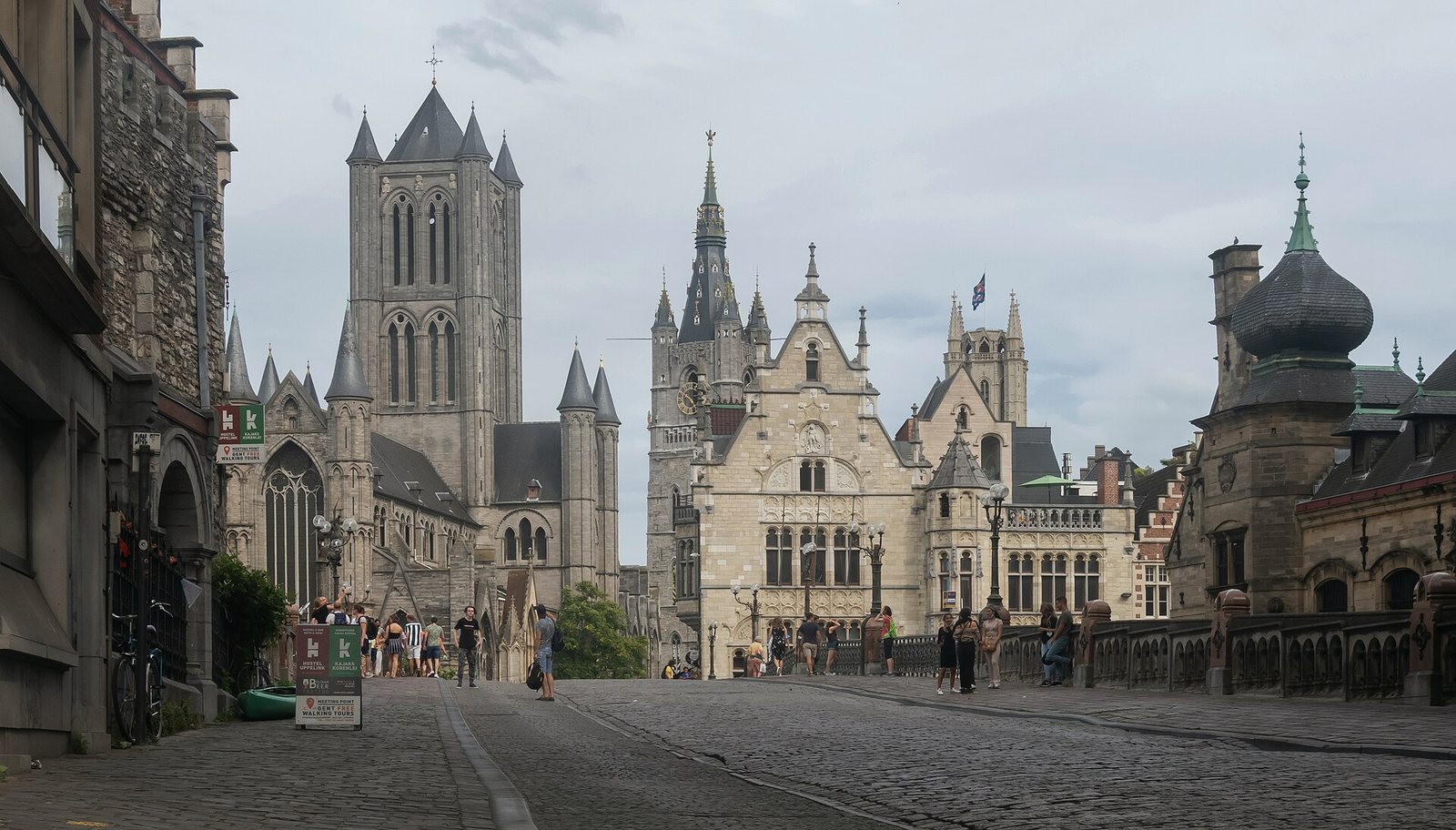
From the cathedral you can see the **Belfry**, with a lift to the top, and **Saint Nicholas' Church**. Together they form the famous line of three towers. Walk on to the **Graslei** and **Korenlei**, two quays lined with guild houses facing each other across the river Leie; this is where locals sit on the edge of the water with a drink on summer evenings. The view from **Saint Michael's Bridge** takes in all three towers at once.
The Gravensteen and Patershol
The **Gravensteen**, the Castle of the Counts, is a moated twelfth century fortress right in the city. Its audio tour, narrated with humour by a local comedian, makes it a hit with families. Behind it, the **Patershol** is a maze of narrow lanes with good restaurants, and the **Vrijdagmarkt** square hosts a market on Fridays and Saturdays.
Museums and street art
The **Museum of Fine Arts (MSK)** has Flemish masters and Belgian modern art, and the **S.M.A.K.** modern art museum faces it across the Citadelpark. The **STAM** city museum explains how Ghent grew, and the **Design Museum** reopens in stages. Don't miss **Werregarenstraat**, an alley where graffiti is legal and the walls change constantly, and the **House of Alijn**, a charming museum of everyday life in the twentieth century.
Food, drink and nightlife
Ghent claims more vegetarian restaurants per person than almost any city in Europe, and many places offer a meat-free day on Thursdays. Try the local specialities **Gentse waterzooi**, a creamy chicken or fish stew, and **cuberdons**, purple cone-shaped sweets sold from carts at the Groentenmarkt. Beer cafés such as **Het Waterhuis aan de Bierkant** and **'t Dreupelkot**, a jenever bar, are institutions. The student quarter around the Overpoort is loud and lively until very late.
Festivals
For ten days in July, the **Gentse Feesten** turns the centre into one of Europe's biggest free street festivals, with music, theatre and crowds. It is a joy if you love a party, but accommodation is scarce and expensive, so book early or avoid those dates if you want quiet. The **Ghent Light Festival** runs every few years in winter.
Getting there and staying
Most trains stop at **Gent-Sint-Pieters**, about two kilometres south of the centre; tram 1 runs from right outside to the Korenmarkt. Ghent's centre has a low emission zone and a circulation plan that makes driving difficult, so leave any car at a park and ride. Stay in the historic centre or around the Patershol to be within walking distance of everything.
Questions about Ghent
Is Ghent worth visiting if I have seen Bruges?
Yes. Ghent has similar medieval beauty but feels more authentic and lived in, with better nightlife and food, and it has the Ghent Altarpiece.
How do I get from Gent-Sint-Pieters station to the centre?
Take tram 1 towards the centre and get off at the Korenmarkt, about ten to fifteen minutes. Walking takes around thirty minutes.
Do I need to book the Ghent Altarpiece?
It is wise in summer, at weekends and in school holidays. Book a timed ticket on the cathedral's official website.
When is the Gentse Feesten?
It runs for ten days in the second half of July, ending on the Monday after the third weekend. Confirm exact dates on the festival's official site.
Facts checked . Fees, schedules and entry rules change, so always confirm the latest with the official source.