At a glance
- Best for
- History, architecture, museums, food and family visits
- Airports
- Sheremetyevo (SVO), Domodedovo (DME), Vnukovo (VKO)
- Time needed
- Three to five days
- Best season
- May to September, and December to February for snow
- Language
- Russian
- Getting around
- Metro, Central Circle trains, buses and app taxis
Why visit Moscow
Moscow is where most journeys into Russia begin, because it has the most international connections, the most hotels and the main rail links to St Petersburg, the Golden Ring and Kazan. It is also a city of contrasts: medieval monasteries beside Stalin's seven skyscrapers, quiet courtyards behind eight lane avenues, and neighbourhoods that feel more like Paris or Berlin than the stereotype.
Before planning, read your government's current travel advice. The UK, US and many others advise against all travel to Russia. Moscow has been the target of drone attacks during the war in Ukraine, and airports sometimes close at short notice. Foreigners have been detained on questionable grounds, so keep a low profile on politics.
The main sights
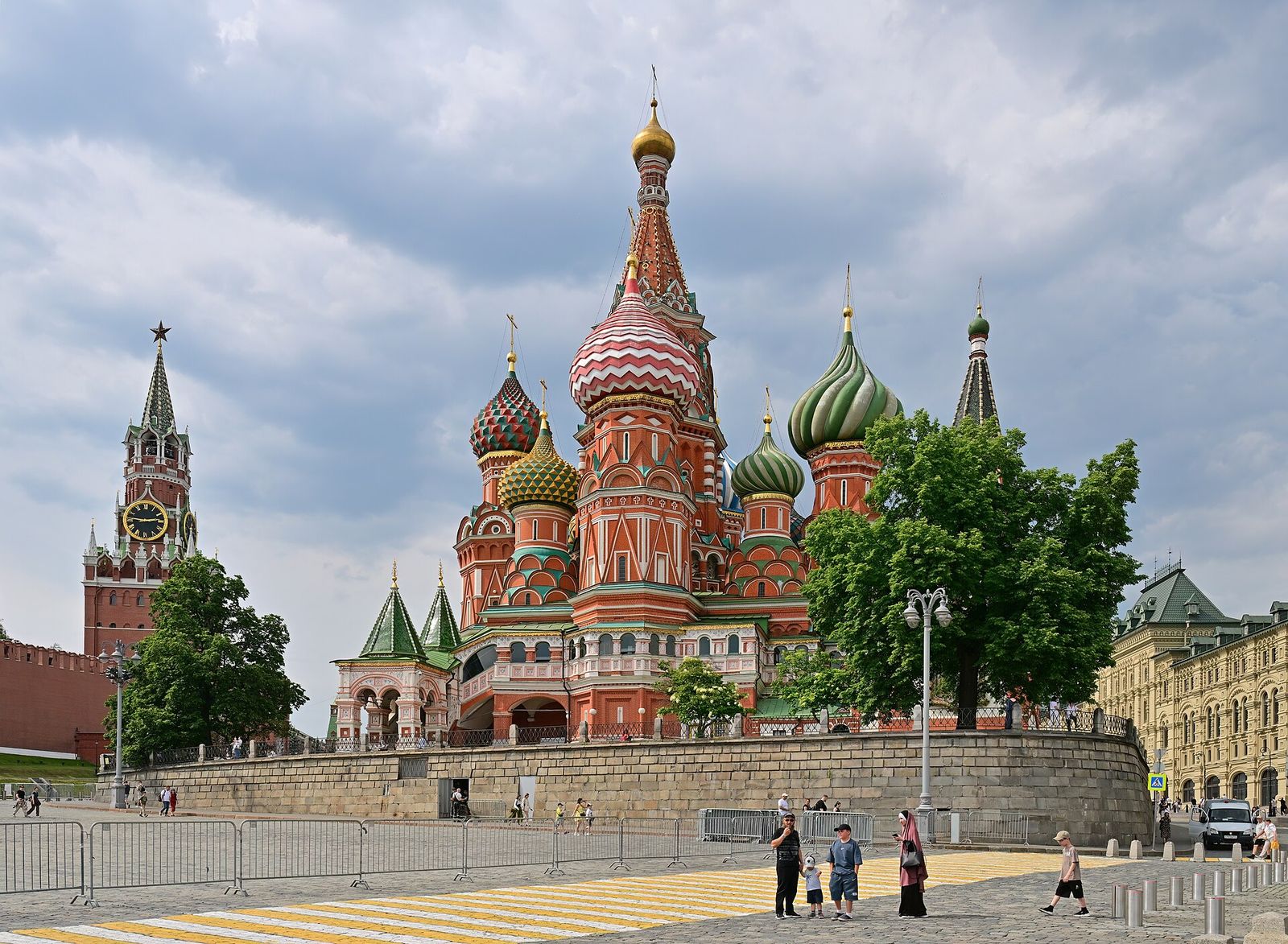
**Red Square** is the place to start, with **St Basil's Cathedral** at one end, the red walls of the Kremlin along one side, Lenin's Mausoleum, the State Historical Museum and the GUM department store, whose glass arcades are a sight in themselves.
**The Moscow Kremlin** contains cathedrals where tsars were crowned and buried, the Armoury Chamber with its Fabergé eggs and royal carriages, and the Diamond Fund. Tickets are timed and sell out in summer, so book online through the official museum site.
**Zaryadye Park**, beside Red Square, is a modern park with a floating bridge over the Moskva River and landscapes from across Russia's climate zones. **The Moscow Metro** is an attraction of its own: ride the Circle Line and stop at Komsomolskaya, Novoslobodskaya, Mayakovskaya and Ploshchad Revolyutsii for chandeliers, mosaics and stained glass.
For art, the **State Tretyakov Gallery** holds the great collection of Russian painting from icons to Repin, while the **Pushkin State Museum of Fine Arts** covers European masters. **New Tretyakov** and **Garage Museum of Contemporary Art** sit in and near Gorky Park. An evening at the **Bolshoi Theatre** is the classic splurge; book well ahead through the official site.
Neighbourhoods to explore
**Kitay-Gorod and Zaryadye** are the oldest trading quarter, with small churches tucked between offices. **Arbat Street** is touristy but fun for a stroll; the quieter lanes around it are lovely. **Patriarch's Ponds** is a leafy, upmarket area of cafés and restaurants, and the setting of Bulgakov's The Master and Margarita. **Zamoskvorechye**, south of the river, is full of merchant houses, churches and the Tretyakov. **Gorky Park** and the riverside **Muzeon** sculpture park make a great afternoon, as does **VDNKh**, the vast Soviet exhibition park with gilded fountains and pavilions.
Further out, **Kolomenskoye** is a riverside estate with a UNESCO listed tent roofed church, and **Novodevichy Convent** has a beautiful cemetery where Chekhov and many Soviet figures are buried. **Izmailovo Kremlin** is a mock wooden fortress next to a weekend flea market good for souvenirs.
Food and drink
Moscow eats well. Try **pelmeni** dumplings, **borscht**, **blini** with sour cream or caviar, **syrniki** for breakfast and Georgian dishes such as khachapuri and khinkali, which Russians love. **Food halls** like Depo near Belorusskaya and the Danilovsky Market are easy places to sample many cuisines at once. Coffee culture is strong, and you will find good independent cafés in almost every central district.
Getting around
The metro is fast, cheap by European standards and easy once you learn the Cyrillic station names; signs and announcements are also in English on many lines. The **Moscow Central Circle** and the **Aeroexpress** trains link the city with Sheremetyevo, Domodedovo and Vnukovo airports. App taxis through Yandex Go are widely used, though you will need a payment method that works in Russia or to pay cash where the driver accepts it.
Practical tips
Carry your passport, since police can ask for it, and keep a copy of your registration and migration card. Avoid photographing government or military buildings. Foreign bank cards do not work, so plan cash carefully. Evenings in the centre are generally lively and calm, but watch for pickpockets on the metro and in crowded tourist areas.
Questions about Moscow
How many days do I need in Moscow?
Three full days covers Red Square, the Kremlin, the metro, a gallery and a park or two. Five days lets you add Kolomenskoye, VDNKh and a day trip to Sergiev Posad.
Is Moscow safe for tourists?
Central Moscow has moderate street crime, mostly pickpocketing. The bigger risks are political and war related: drone attacks, airport closures and arbitrary detention. Read your government's advice and stay away from protests.
Which Moscow airport is best?
It depends on your airline. Sheremetyevo handles Aeroflot and many foreign carriers, while Vnukovo and Domodedovo serve others. All three link to the city by Aeroexpress train or taxi.
Can I visit the Kremlin without a tour?
Yes. Buy timed tickets online through the official Kremlin museums site and enter through the Kutafya Tower. The Armoury needs a separate ticket.
Facts checked . Fees, schedules and entry rules change, so always confirm the latest with the official source.